Net Zero by 2050: Ambition is Not a Strategy
In June 2019, in the final days of her premiership, Theresa May signed the UK’s net zero by 2050 target into law. It passed with cross party support and was hailed at the time as a historic act of political leadership. The UK became the first major economy in the world to legislate for net zero greenhouse gas emissions, and the Committee on Climate Change (CCC) had concluded that it was technically achievable.
What often gets lost in political speeches is the sheer scale of what net zero actually means. It is not simply about building more wind farms or reducing emissions from electricity generation. It requires changes across almost every part of modern life: heating our homes, powering transport, running industry, managing agriculture, and producing food.
The challenge was never whether net zero sounded good on paper. The challenge was whether governments were prepared to make and sustain the difficult decisions needed to deliver it.
For years, the UK’s own climate advisers warned that progress was falling behind ambition. By 2023, the CCC reported that only 11 of 50 key indicators necessary to meet future carbon targets were on track. That is less than a quarter of what was required.
This raises an uncomfortable question.
Is passing a law enough if there is no realistic pathway to achieve it?
The Problem with Deferred Decisions
Politicians often favour long-term targets because they create the appearance of action without requiring immediate sacrifices.
Legislating for net zero created a framework that future governments would have to follow. But many of the most politically difficult decisions were left for another day.
Questions around home insulation, gas boilers, electric vehicle adoption, industrial transformation, and agricultural reform were largely postponed. Future governments inherited the responsibility, while the original decision-makers received the credit.
That is not necessarily climate leadership. It can also be viewed as political risk management.
Ambition without delivery is not a plan.
The Cost of Transition Matters
One reality frequently overlooked in climate debates is that the costs of transition do not fall equally across society.
A wealthy household may be able to purchase an electric vehicle, install solar panels, or replace a gas boiler with a heat pump. Many lower-income households cannot.
For families already struggling with food, housing, and energy costs, additional expenses can feel less like environmental progress and more like another financial burden.
A successful energy transition must be both environmentally effective and socially sustainable. If ordinary people lose confidence in the process, political support will inevitably weaken.
Climate goals that cannot maintain public support are unlikely to survive changes in government.
Why Sunak’s 2023 Decision Matters
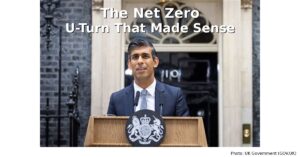
In September 2023, Prime Minister Rishi Sunak announced several significant changes to the UK’s net zero timetable. Most notably, he delayed the planned ban on the sale of new petrol and diesel vehicles from 2030 to 2035 and scaled back certain housing retrofit requirements.
His critics viewed the move as a retreat from climate leadership.
Supporters saw something different.
Sunak argued that the transition should proceed at a pace that households could realistically afford. Whether one agrees with his wider climate policies or not, he highlighted a problem that many politicians were reluctant to discuss openly: who ultimately pays for net zero?
That question matters.
Ignoring affordability concerns does not make them disappear. In fact, doing so may strengthen opposition to climate policies altogether.
The Debate We Need
The choice facing the UK is not between climate action and economic reality.
The real challenge is finding a pathway that achieves both.
The country needs honest conversations about costs, timelines, technology, energy security, industrial competitiveness, and living standards. It needs policies that are technically achievable, economically realistic, and politically durable.
Most importantly, it needs leaders willing to admit that slogans are not solutions.
Net zero may remain the destination.
But unless the route is practical, affordable, and supported by the public, the destination risks becoming nothing more than a political aspiration.
The debate should not be about whether we care about climate change.
It should be about whether we are building a transition that people can actually follow.