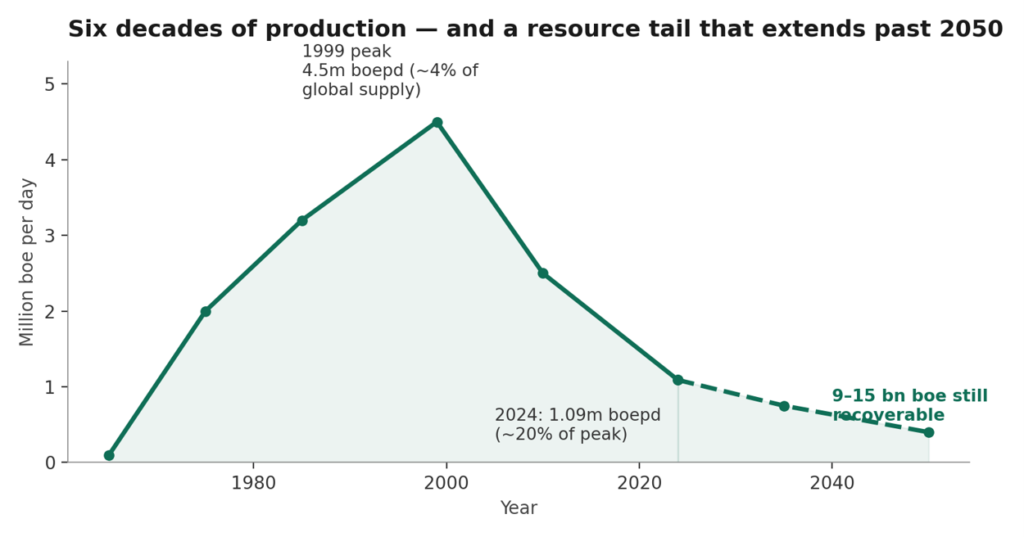
Every time the UK Continental Shelf comes up in conversation, someone reaches for the word “mature.” It’s usually said with a slight wince, the way you’d describe a colleague who’s clearly past their best years, but you don’t want to be rude about it. And in the strictly geological sense, the word fits. The UKCS has been producing since BP discovered the West Sole gas field in 1965, production peaked at around 4.5 million barrels of oil equivalent a day in 1999, and by 2024 that figure had fallen to roughly a fifth of its peak. Some 47.7 billion barrels have already come out of the ground.
But here’s where the story usually stops short, and where it shouldn’t. “Mature” describes where the basin is in its life. It says nothing about whether the basin still has value. And on that question, the numbers are unambiguous.
The Scale of What’s Actually Left
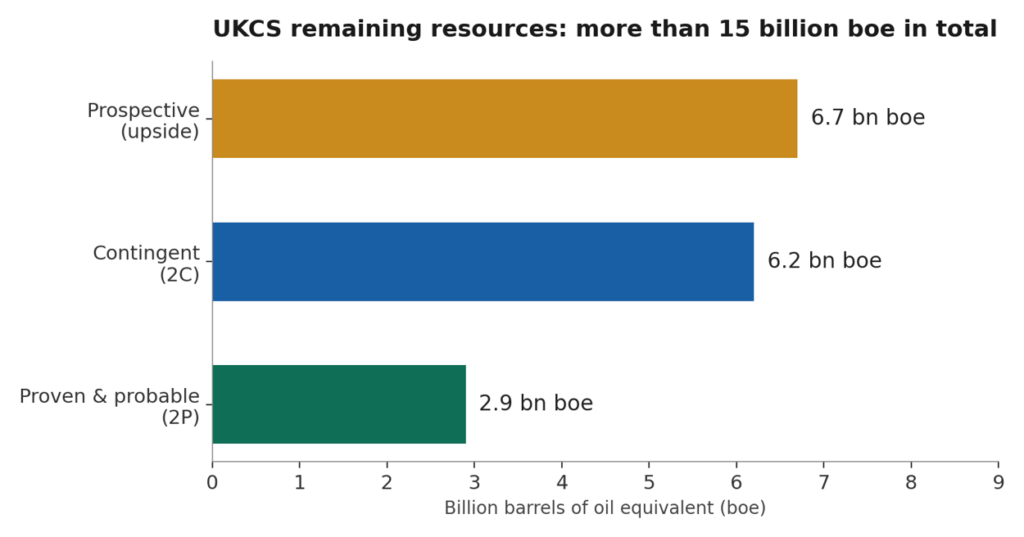
The North Sea Transition Authority’s most recent Reserves and Resources Report, published in October 2025, puts the basin’s remaining potential at an estimated 15.8 billion barrels of oil equivalent. An upward revision of 1.1 billion barrels on the previous estimate, driven largely by a 31% jump in prospective resources following the 33rd Licensing Round.
Break that figure down and it gets more interesting, not less. Proven and probable reserves, petroleum from known fields that’s about as close to guaranteed as this industry gets; stand at 2.9 billion boe. At current production rates, that’s roughly seven years of domestic supply sitting in fields we already know about. Add the 6.2 billion boe of contingent resources, meaning oil and gas that’s been discovered but not yet greenlit for development, and you’re looking at 9.2 billion boe, or nearly a fifth of everything the basin has produced across six decades.
Westwood Global Energy Group has modelled what this could mean out to 2050. In a base case, the UKCS could yield another 4.3 billion boe. Under more favourable conditions, stable fiscal policy, quicker approvals, continued licensing, that figure rises to 7.5 billion boe. The detail that matters most in Westwood’s analysis is this: the downgrade from a 2019 projection of 6.5 billion boe to today’s lower estimate of 3.8 billion isn’t because the geology changed. It’s because investor confidence did. The oil is still there. What’s missing is the policy environment to go and get it.
A Resource Tail That Runs Past 2050
It’s worth visualising what “still has a lot to give” actually looks like against six decades of production history. The basin’s curve isn’t a cliff edge, it’s a long tail, and that tail still has billions of barrels in it.
West of Shetland: A Frontier Hiding in Plain Sight
If you want a single region that captures the gap between perception and reality, it’s West of Shetland. Despite the first major discovery here occurring nearly 40 years ago, an estimated 95% of the resources in this region remain unproduced. Since 1972, only 151 exploration wells have been drilled across the entire area, a remarkably small number given its size and the quality of what’s already been found.
BP’s Clair field, discovered in 1977, holds an estimated 3 to 5 billion barrels of oil in place, making it one of the largest accumulations ever found on the UKCS. Schiehallion, Foinaven, and Clair Ridge have all demonstrated since that this geology, difficult, fractured, deepwater, is commercially workable with the right technology. Recent 3D seismic work suggests over 3 billion barrels in the subsurface of the area alone, with further upside in underexplored Mesozoic plays.
This isn’t speculative geology. It’s proven potential that the industry has barely begun to test.
Rosebank, Cambo and Jackdaw Aren’t Marginal Projects
These three names dominate the UK energy debate, and for good reason. Rosebank, roughly 150km north-west of Shetland, is the largest undeveloped oil and gas field on the UKCS, holding nearly 500 million barrels of oil equivalent. Equinor has already installed all nine subsea structures. Wood Mackenzie estimates that developing Rosebank and Cambo together would generate £40 billion in UK gross value added.
Cambo, at the junction of the Westray and Corona ridges, could deliver up to 170 million boe over a 25-year life, with a modern, potentially fully electrified design that Ithaca Energy describes as among the lowest-emission concepts in the North Sea. Jackdaw, operated by Shell, is expected to produce around 40,000 boepd for two decades, and Shell told the courts that even a single year’s delay would cost upward of £200 million.
These are 20-to-30-year production horizons. That’s not winding down a basin. That’s planning a future for it.
The Real Choice Isn’t Production vs. No Production
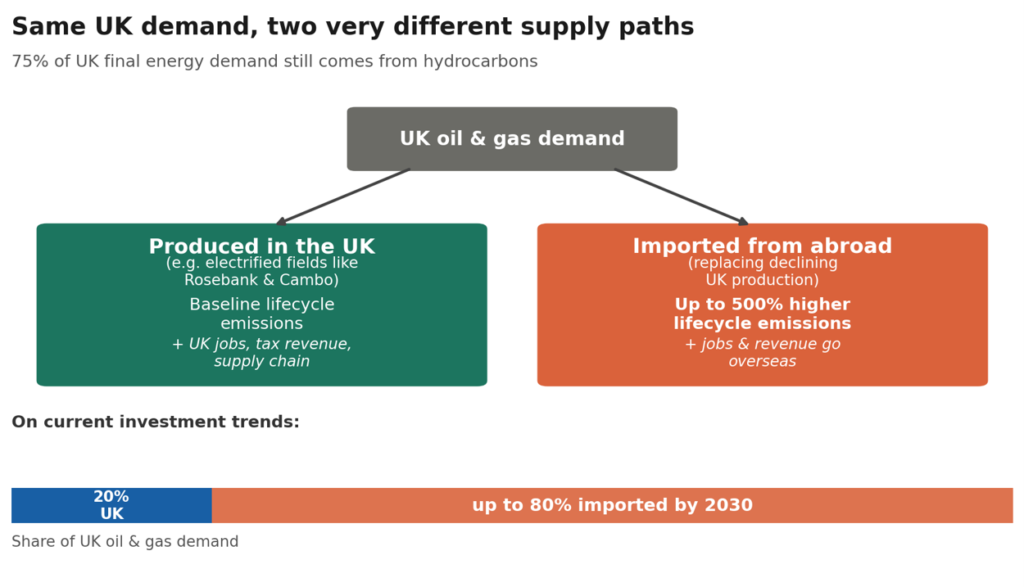
The UK still gets roughly 75% of its final energy demand from hydrocarbons, and that won’t change quickly regardless of how the North Sea is managed. The Climate Change Committee’s own balanced net zero pathway assumes a residual UK oil and gas requirement of around 15 billion boe through to 2050. The question, then, isn’t whether the UK will keep using hydrocarbons, it’s where they’ll come from.
On current trajectories, the UK could be importing up to 80% of its oil and gas by 2030. And imported barrels aren’t carbon-neutral: Wood Mackenzie’s analysis found that imported oil can carry up to 500% more lifecycle emissions than oil from electrified domestic projects like Rosebank and Cambo. Shutting down UK production while demand stays flat doesn’t lower global emissions. It just moves them somewhere with a worse carbon footprint and sends the jobs and tax revenue with them.
Maturity Isn’t a Verdict
The UKCS is mature. That’s a fact, not an argument. But a basin holding between 9 and 15 billion barrels of recoverable resource, sitting beneath one of the most sophisticated offshore engineering ecosystems in the world, isn’t a basin that’s finished. It’s one that’s waiting for the right conditions to keep giving. The geology hasn’t gone anywhere. The question is whether the policy will catch up to it.
Hi, this is a comment.
To get started with moderating, editing, and deleting comments, please visit the Comments screen in the dashboard.
Commenter avatars come from Gravatar.