By the time the UK government gets around to replacing the Energy Profits Levy (EPL) in 2030, there may not be much of a North Sea industry left to save.
That is not hyperbole. It is where the data points.
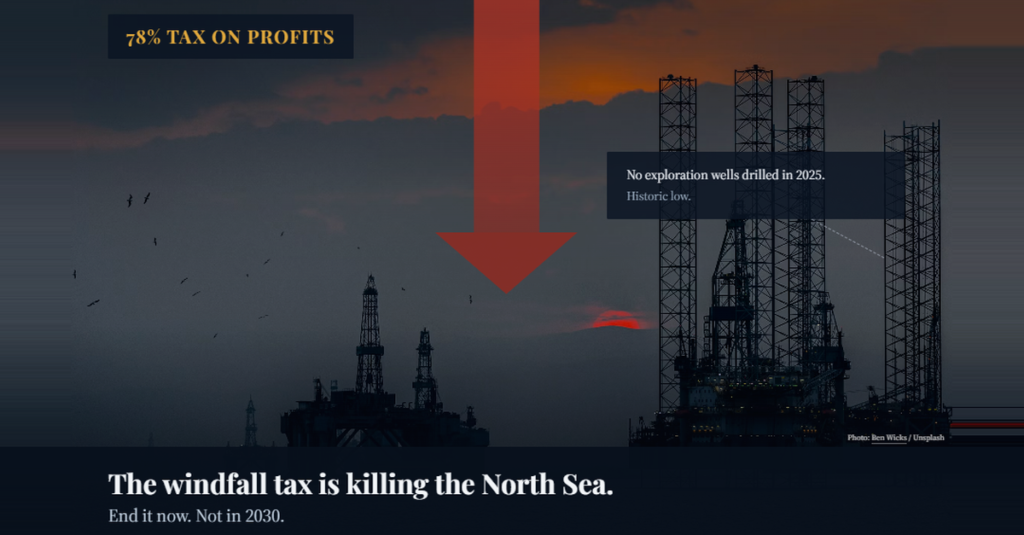
Right now, the UK is taxing its own oil and gas producers at 78% on profits. That is one of the highest effective tax rates on any hydrocarbon-producing basin anywhere in the world, more than double the rate applied in the US Gulf of Mexico. Harbour Energy, the North Sea’s largest independent producer, said the levy had “all but wiped out” its annual profit. Companies are not just tightening their belts. They are leaving. Equinor and Shell merged their UK operations. Eni combined with Ithaca Energy. TotalEnergies agreed to fold its British business in with Repsol and HitecVision. And in May 2026, Bloomberg reported that BP was reviewing whether to exit the North Sea entirely.
This is not a cycle. It is a structural retreat. And structural retreats do not reverse themselves when a policy eventually changes.
The original case for the tax no longer holds
The windfall tax was introduced in May 2022. The context was real: gas prices had spiked after Russia’s invasion of Ukraine, energy companies were reporting record profits, and families were choosing between heating and eating. A temporary surcharge on extraordinary profits was defensible in that moment. No one seriously argues otherwise.
But that moment has passed. Oil and gas prices have fallen substantially from their 2022 peaks. The “windfall” that justified the levy name has, for most North Sea operators, long since disappeared. Yet the tax has not been cut. It has been increased three times. It now runs until 2030, with no adjustment mechanism when profits fall back to normal levels.
Compare that to the electricity generator levy introduced at the same time. That one only kicks in above a benchmark price. Below the threshold, it stops. Oil and gas operators have no such protection. They pay 78% whether profits are extraordinary or entirely ordinary. The tax has stopped being a windfall tax. It is just a punitive permanent surcharge.
The damage is happening right now, not in some future scenario
In 2025, not a single exploration well was drilled anywhere on the UK Continental Shelf. That is a historic low. Zero. Offshore Energies UK has projected that capital investment in UK projects could fall from 14.1 billion pounds to just 2.3 billion pounds between 2025 and 2029 under the current regime. That is an 80% collapse in spending.
The jobs numbers are just as stark. The sector is losing roughly 1,000 jobs a month. Robert Gordon University’s Energy Transition Institute puts the cumulative loss as high as 95,000 by 2030 if investment continues to drain away. These are not corporate back-office redundancies. They are engineers, offshore technicians, subsea specialists and supply chain workers concentrated in communities in Aberdeen and the north-east of Scotland, where comparable employment at comparable scale does not exist elsewhere.
Tax receipts are falling too. HM Revenue & Customs data showed that North Sea oil and gas revenues fell by 1.6 billion pounds in 2024/25. EPL receipts themselves dropped 20%. The Office for Budget Responsibility forecasts that UK tax revenues from the sector will collapse from 2.7 billion pounds in 2025/26 to just 300 million by 2030. The government is destroying the tax base it set out to exploit.
Offshore Energies UK has modelled what ending the EPL in 2026 rather than waiting until 2030 would actually mean for the public finances. The answer: 15.7 billion pounds more in tax receipts over the following ten years. Not less. More. Because a functioning industry generating sustainable investment generates far more revenue over time than a declining one being squeezed to death.
Waiting until 2030 is the wrong call
The government has pledged a new fiscal framework by 2030. That sounds reasonable until you understand what happens to a mature offshore basin in the intervening four years when investment has stopped.
Supply chains do not hibernate. They close. Fabrication yards repurpose or shut. Specialist vessels get sold to other basins. Engineers retire early or retrain. Skills that took decades to develop disperse. When the fiscal environment eventually improves, the companies that might have invested will find that the people and the infrastructure they needed are no longer there.
Robin Allan, chairman of BRINDEX, the offshore industry trade body, put it simply: “An accelerated decline of North Sea output will see UK dependency on imports reach more than 85% by 2030. The windfall tax is self-defeating and it should be removed.“
He is right. The North Sea currently supplies around half of the UK’s energy needs. As domestic production falls, the UK imports more. Those imports often carry a higher carbon footprint than the gas produced at home, because LNG shipped from the US or Qatar involves significant methane emissions from liquefaction and transport. The environmental case for the windfall tax is far weaker than its supporters claim.
The fairness problem that nobody wants to talk about
A windfall tax is meant to apply to profits that arise from luck rather than effort: external conditions beyond a company’s control that hand it an extraordinary gain. If that is the principle, the application has been spectacularly inconsistent.
Tesco’s pre-tax profit rose 160% in a single year during the same period that oil and gas companies were being told their extraordinary profits justified a special tax. Not a penny of windfall tax was levied on Tesco. Nor on the banks, nor on the pharmaceutical sector, all of which recorded substantial profit surges in the same inflationary environment. Oil and gas companies were targeted not because the economic logic was applied consistently, but because they were a politically easier target.
That inconsistency corrodes trust. It tells every business with long-cycle capital investment decisions that the UK’s fiscal framework can be rewritten at any time, based on political convenience rather than principle. That signal does not stay in the North Sea. It echoes across every infrastructure investment decision in the country.
What needs to happen
The government should end the Energy Profits Levy now and replace it immediately with the price-linked Oil and Gas Price Mechanism it has already been developing. A mechanism that rises when prices genuinely spike and falls when they do not is economically coherent, fiscally productive, and defensible on the original windfall tax rationale. The current flat-rate surcharge is none of those things.
It should also fast-track approvals for projects like Rosebank and Jackdaw that have been stalled in regulatory and political limbo. Every month of delay is investment that goes to Norway, Guyana or the Gulf of Mexico instead.
The North Sea is not asking to escape taxation. It is asking for a tax regime that reflects economic reality, applies consistently across sectors, and does not punish investment in an industry that the country still depends on.
Waiting until 2030 to fix this is not a plan. It is a decision to let irreversible damage accumulate for four more years in the hope that something can be salvaged at the end. The companies restructuring, the workers leaving, the supply chains winding down, they will not wait.
The question is whether the government will act before the answer becomes clear on its own.