On 30 October 2026, bp reported $4.0 billion of impairments for the third quarter, mostly in what it calls its transition businesses. In the same quarter it made $8.5 billion in underlying profit, helped by high prices and strong refining margins. Meanwhile, the UK government is holding firm on its clean power plan.
So here is the question I keep coming back to. If the companies expected to build the energy transition keep writing it down, should the government still put it first? I looked at bp, at floating offshore wind, and at what both sides of the argument say. The evidence is messier than either camp likes to admit.
bp keeps writing it down
An impairment is a company admitting that an asset is worth less than it paid or planned. On 13 October 2026, bp warned that this quarter’s charges would be $3.0 to $4.5 billion, “primarily attributable to transition businesses in the gas & low carbon energy segment.” It has not said which ones.
This is a pattern, not a one-off. bp booked $1.69 billion of net impairments and losses on asset sales in the first half of 2026, including $525 million on transition businesses. For 2025 the figure was $6.04 billion, mostly linked to Lightsource bp (solar) and Archaea Energy (biogas), with charges on offshore wind too.
The strategy has moved to match. In February 2025, bp raised oil and gas investment to about $10 billion a year, cut low carbon spending to $1.5 to $2 billion, and set a $20 billion disposal target for 2027. Last month, chief executive Meg O’Neill put it bluntly: “We have not been careful stewards of shareholder capital.” A strategy update is due on 15 December 2026.
Impairments partly reflect what bp paid and when, not just how a whole sector is doing. Still, one of the world’s biggest energy companies is telling its shareholders that, for bp, the transition has not paid.
Floating wind: where the cost is clearest
Floating offshore wind puts turbines on floating platforms in deep water. The UK has the second-largest floating wind pipeline in the world, and it is also where the money problem is easiest to see.
In January, the government announced the results of its seventh Contracts for Difference auction, known as AR7. The strike price is the guaranteed price a generator gets for each megawatt hour (MWh). When the market pays less, bill payers make up the difference. When it pays more, the generator pays the difference back.
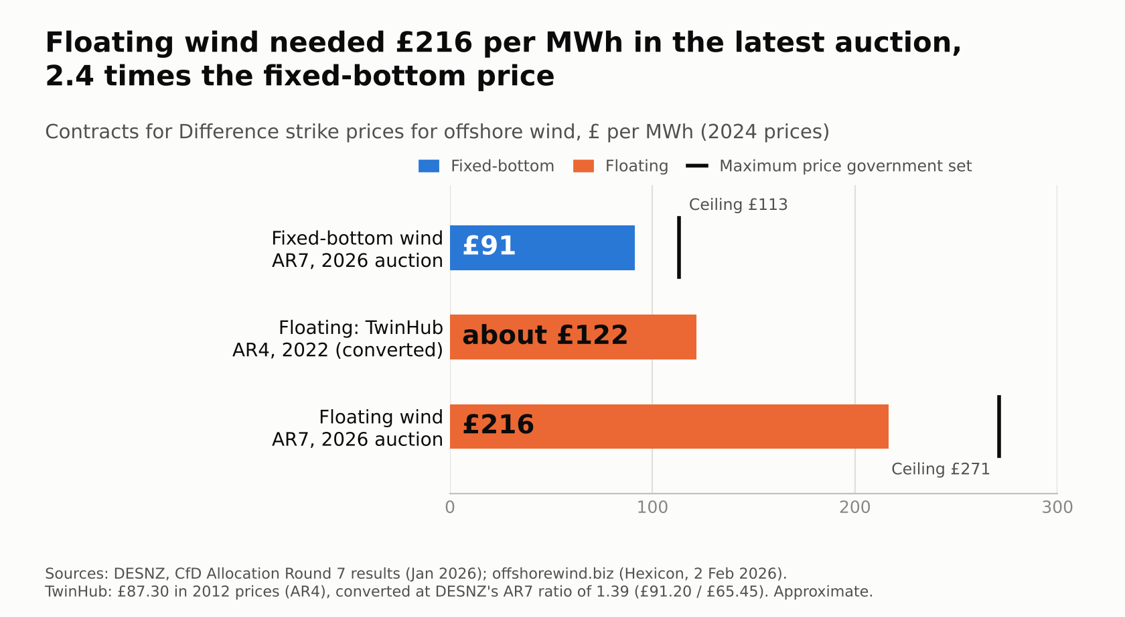
Floating wind won contracts at £216.49 per MWh. Fixed-bottom wind, the kind fixed to the seabed, cleared at £91.20 in England and Wales and £89.49 in Scotland. Floating wind needed 2.4 times the price. The government’s ceilings were £271 and £113.
Only two floating projects won: Erebus (100 MW, Wales) and Pentland (92.5 MW, Scotland). That is 192.5 MW out of 8,437.5 MW awarded, about 2% of the auction.
A strike price is not a profit figure. But when one technology needs 2.4 times the price of its nearest cousin, it is fair to ask whether it can stand on its own yet.
Hexicon: a warning shot
Swedish developer Hexicon won a contract in 2022 for its 32 MW TwinHub project off Cornwall, at £87.30 per MWh in 2012 prices, roughly £122 today. Then inflation and supply chain costs ate into the numbers. In January 2026 it booked a SEK 115 million impairment (about €11 million). In April the contract was terminated, and Hexicon sold the whole project, liabilities included, for £1.
On 6 November, Hexicon’s board published a balance sheet for liquidation purposes after its auditor, KPMG, declined to give an opinion, citing uncertainty over financing. Shareholders vote on 25 November 2026 on whether to wind the company up or carry on.
To be fair to Hexicon, it is not insolvent on paper. Its equity is well above the legal threshold, the meeting was called as a precaution, and the board recommends continuing. But it admits its funding is not yet secured. Hexicon also still holds a 5.5% stake in Pentland, one of the two floating winners in AR7.
Others are stepping back too
Shell left floating wind in November 2025, handing MarramWind (3 GW) to ScottishPower and returning the CampionWind lease (2 GW) as it refocused its power business on trading and retail. In April 2026, Vattenfall sold its stake in Muir Mhòr (up to 1 GW), citing “portfolio priorities”. Neither blamed cost, nor I won’t put words in their mouths. But the pattern is hard to miss.
Big plans, very little steel
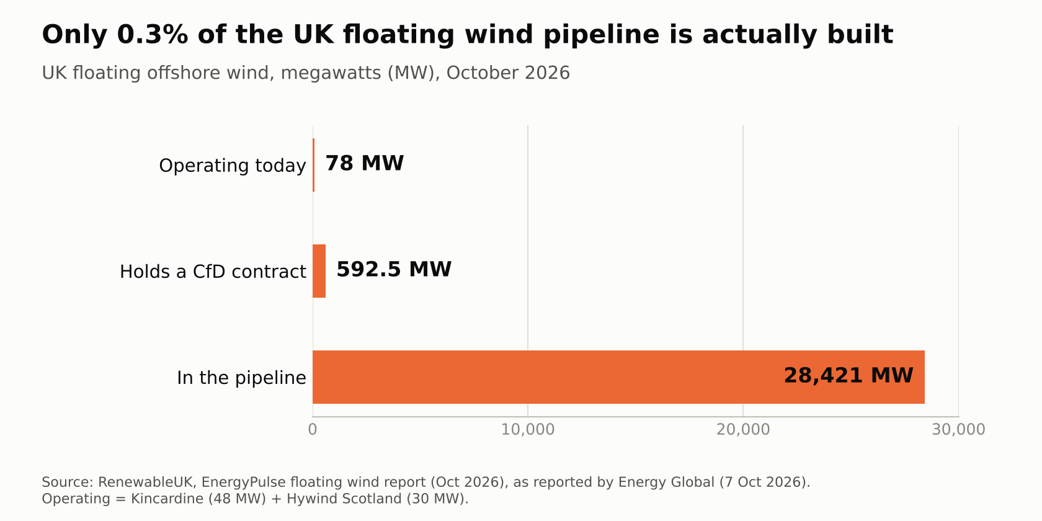
RenewableUK counts 28.4 GW of floating wind in the UK pipeline, second only to Italy. Just 78 MW is running at Kincardine and Hywind Scotland, and another 592.5 MW holds a contract. Its own forecast is 274 MW operating by the end of 2030, 1 GW by 2032 and 3 GW by 2034.
The government’s case
The government’s argument is not about company profits. Ed Miliband said, “the sprint for clean power is the best way to reliably bring down bills”, argued that renewables are cheaper than gas, and called dependence on global fossil fuel markets the UK’s “energy Achilles heel”. The aims are clean power for 95% of electricity by 2030, net zero by 2050, and £300 off the average household bill by 2030.
There is evidence on its side. AR7 was Europe’s biggest offshore wind auction, and almost all of it was fixed-bottom. The first offshore wind contracts in 2015 were £114.39 and £119.89 per MWh in 2012 prices. AR7’s fixed-bottom price was £65.45 in the same prices, more than 40% lower. Developers still want in, too: five fixed-bottom projects won in England and Wales alone.
Gas is the other half of the argument. UK oil and gas output is around one million barrels of oil equivalent a day and falling. Jackdaw, approved on 21 October 2026, would cover just under 4% of Britain’s daily gas demand at its peak. Energy prices surged during the Iran war, which is exactly the exposure clean power is meant to reduce.
The critics’ case
The Conservatives and Reform UK argue that net zero is pushing bills up. When Miliband made his defence in October 2025, bills had just risen 2% under the price cap, and renewables carry levies and grid costs that a headline strike price does not show. Conservative Claire Coutinho has called on the government to be “clear-eyed and honest with the public” about the full cost.
Critics also point to the auction ceilings. The £271 cap for floating wind was more than double the £113 cap for fixed-bottom, which sits awkwardly with the claim that renewables are always cheaper than gas.
Then there is the North Sea. The ban on new exploration licences stays. The November 2025 Budget kept the 38% windfall levy until 2030, so producers face a headline tax rate of 78% while prices stay above the government’s thresholds. The Office for Budget Responsibility expects North Sea tax receipts to fall from £2.7 billion in 2025-26 to £0.3 billion by 2030-31. In fairness, the government has approved Jackdaw, is allowing new fields that tie back to existing infrastructure and has launched a £2 billion Energy Wealth Fund to turn North Sea revenues into clean energy investment.
So, rethink or stay the course?
I don’t think bp’s figures resolve the issue either way. These three questions are likely to be more revealing:
- Whose profit counts? The government judges on bills and energy security, not company returns. But company returns decide who builds. Contracts for Difference exist to give builders certainty, and AR7 shows plenty still want them. The harder question is who carries the risk at £216.
- Which part of the transition? bp’s 2025 write-downs were mostly solar and biogas. Fixed-bottom wind is clearing at about £91 with strong demand, while floating wind needs 2.4 times that. Calling all of it “the transition” hides the differences.
- Compared with what? Gas still sets the power price much of the time, and the North Sea is declining. Any rethink has to say what replaces those megawatt hours, and at what cost.
The evidence can be read in more than one way. Some interpret the oil majors’ retreat as a warning that costs are rising too quickly, and the transition should slow down. Others see businesses pursuing shareholder interests rather than national priorities and favour staying the course while taking a harder look at the most expensive technologies. Both arguments have merit.
Floating wind may well get there. Fixed-bottom wind did. ORE Catapult estimates that standardising floating foundations could cut their cost by up to 17%, and that bringing financing costs closer to fixed-bottom levels could save almost 20%. But “may get there” is a hope, not an energy policy.
The questions we should be asking
- At what price does floating wind stop being worth it for bill payers, and who decides?
- If companies keep writing down transition assets, what evidence would actually change the policy?
- Should the full cost of the transition, including levies and grid upgrades, be published alongside the benefits?
- Does it make sense to squeeze the North Sea basin that built the offshore skills the transition depends on?
- If North Sea receipts fall to £0.3 billion, what will the Energy Wealth Fund have left to invest?
Where do you land? Stay the course, rethink it, or judge each technology on its own merits?
Sources
Prices are in 2024 prices unless stated. The TwinHub conversion (£87.30 to about £122) uses the uplift DESNZ applied in AR7 (£91.20 divided by £65.45, or 1.39), so it is approximate.
- Third quarter 2026 trading statement (13 Oct 2026), via energy-pedia. https://www.energy-pedia.com/news/general/bp-announces-third-quarter-2026-trading-statement-205649
- Third quarter 2026 results ($4.0bn impairments, $8.5bn underlying profit), via energy-pedia (30 Oct 2026). https://www.energy-pedia.com/news/general/bp-announces-q3-2026–results-205898
- Second quarter 2026 results, Form 6-K (H1 2026: $1,689m net impairments and losses on sale; $525m transition businesses). https://www.sec.gov/Archives/edgar/data/0000313807/000031380726000016/bp-20260630.htm
- Fourth quarter 2025 results, Form 6-K (2025: $6,037m net impairments and losses on sale). https://www.sec.gov/Archives/edgar/data/313807/000031380726000002/a31122025bp6kq4.htm
- Bloomberg Law. BP must make better use of shareholder capital, CEO O’Neill says (5 Oct 2026). https://news.bgov.com/environment-and-energy/bp-must-make-better-use-of-shareholder-capital-ceo-oneill-says
- World Oil. bp announces it will pivot back to oil and gas, cut renewables spending (26 Feb 2025). https://worldoil.com/news/2025/2/26/bp-announces-it-will-pivot-back-to-oil-and-gas-cut-renewables-spending/
- Contracts for Difference Allocation Round 7 results (14 Jan 2026). https://assets.publishing.service.gov.uk/media/6966861de8c04eb2919f773a/contracts-for-difference-allocation-round-7-results-.pdf
- ORE Catapult. AR7 results and analysis (Pentland ownership). https://ore.catapult.org.uk/resource-hub/blog/allocation-round-7-ar7-results-and-analysis
- Contracts for Difference auction results, first round (26 Feb 2015). https://assets.publishing.service.gov.uk/media/5a7ffb0ee5274a2e8ab4d776/Contracts_for_Difference_-_Auction_Results_-_Official_Statistics.pdf
- biz. Hexicon books impairment related to TwinHub (2 Feb 2026). https://www.offshorewind.biz/2026/02/02/hexicon-books-impairment-related-to-twinhub-seeks-to-divest-floating-wind-project/
- TGS 4C. Hexicon divests TwinHub floating wind project for £1 (10 Apr 2026). https://www.tgs4c.com/news/hexicon-divests-twinhub-floating-wind-project-for-a31-nid32676.html
- Hexicon AB. Board prepares a balance sheet for liquidation purposes (6 Nov 2026), via finanznachrichten.de. https://www.finanznachrichten.de/nachrichten-2026-11/70061915-hexicon-ab-the-board-of-directors-of-hexicon-has-prepared-a-balance-sheet-for-liquidation-purposes-and-convenes-an-initial-meeting-for-liquidation-pu-399.htm
- EnBW will not continue offshore wind projects Mona and Morgan (Jan 2026). https://www.enbw.com/investors/news-and-publications/enbw-will-not-continue-offshore-wind-projects-mona-and-morgan.html