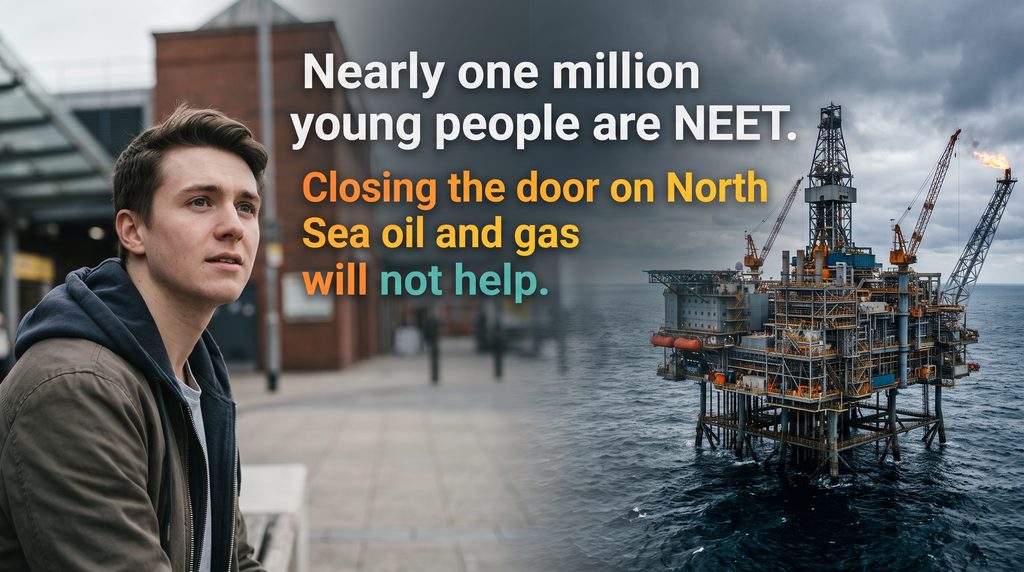
The latest figures from the Office for National Statistics (ONS), published on 27 August 2026, show that 13.0% of people aged 16 to 24 in the UK were not in education, employment or training (NEET) in April to June 2026. That is 981,000 young people, 30,000 more than a year earlier. In the quarter before, the number passed one million for the first time since 2013, reaching 1,012,000, or 13.5% of the age group.
Young men account for most of the rise. 13.7% of young men are NEET, against 12.3% of young women, and men made up 25,000 of the 30,000 increase over the year. Of the 981,000, 393,000 are unemployed and looking for work. The other 588,000 are economically inactive, which means they are not looking at all.
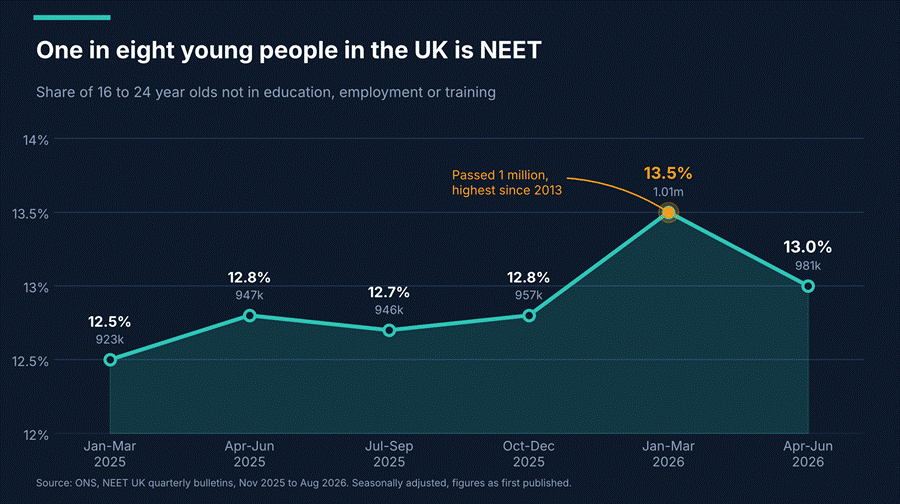
Figure 1. NEET rate for 16 to 24 year olds, UK, January to March 2025 to April to June 2026. Source: ONS.
In the same year, the government has moved to put its North Sea policy into law. The Energy Independence Bill, published in November 2026, removes the North Sea Transition Authority’s power to grant new oil and gas licences. There will be no new exploration in unlicensed areas of the North Sea. Existing fields can keep producing until the end of their lives, and some extra production next to them will be allowed through new Transitional Energy Certificates.
This matters for young people. Upstream oil and gas is one of the few UK industries that has taken on school leavers without degrees, paid them from their first day and trained them for skilled careers. As the basin winds down, those entry routes close. Offshore Energies UK (OEUK), the industry body, says the sector has been losing up to 1,000 jobs a month on average, mostly in the supply chain. Fewer jobs and fewer apprenticeships mean fewer ways out of NEET status for the young people who need them, and the NEET figures are likely to rise as a result.
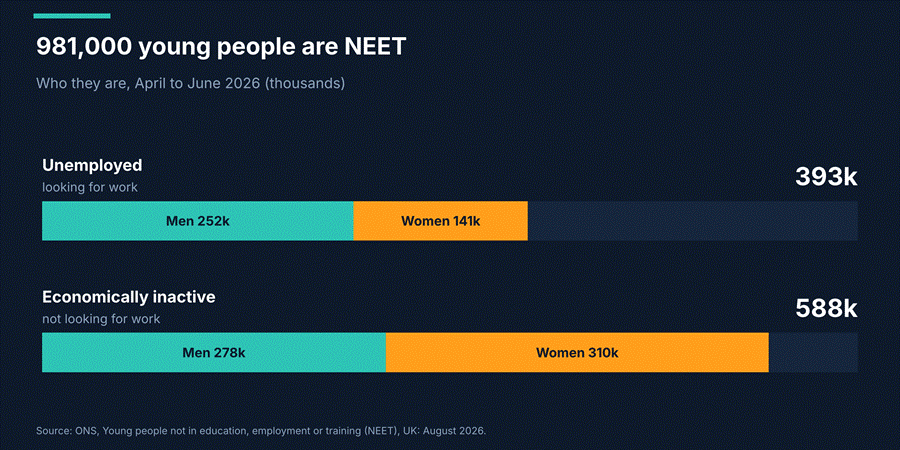
Figure 2. UK NEETs aged 16 to 24 by status and sex, April to June 2026. Source: ONS.
For more than 25 years, the UK upstream oil and gas sector has given young people a practical route into skilled work. The main programme is APTUS, formerly the Oil and Gas Technical Apprenticeship Programme (OGTAP). It has run since 1999. OPITO manages it for the operating companies, and the Engineering Construction Industry Training Board (ECITB) manages it for the contractors.
A proven route into employment
More than 2,000 apprenticeships have been completed through the programme. It offers 300 places a year, and OPITO lists more than 20 participating employers, including bp, Shell, Petrofac, Semco Maritime and Bilfinger. Industry has invested £140 million in it to date. Apprentices train in electrical maintenance, instrument and control maintenance, mechanical maintenance or process operations. Over 95% receive a job offer from their sponsor company when they finish the four-year programme.
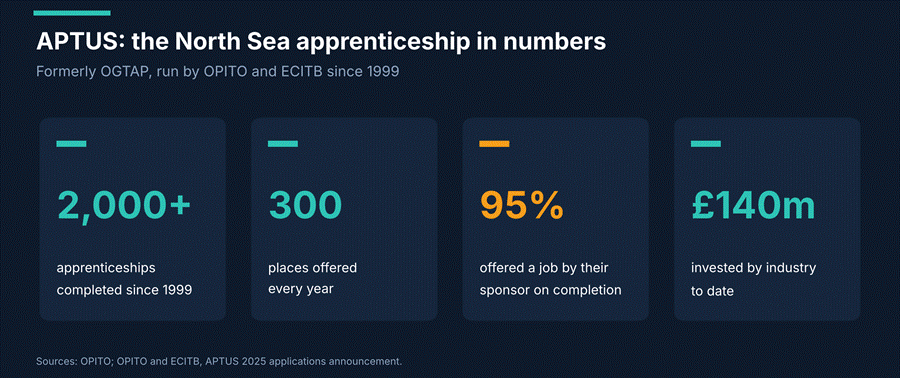
Figure 3. The APTUS (formerly OGTAP) apprenticeship programme in numbers. Sources: OPITO; OPITO and ECITB.
Supporting NEETs and social mobility
Many apprentices join the sector straight from school or after a period of unemployment or economic inactivity. There is no degree requirement. Apprentices are paid a salary, earn technical qualifications and learn in a structured workplace. For many of them, it is the first step into stable, long-term employment.
Creating lifelong careers
Former apprentices have gone on to work as offshore technicians, supervisors, maintenance managers, project engineers and operations leaders. The sector has structured career paths, extensive technical training and internationally recognised qualifications. The same skills are used in offshore wind, hydrogen and carbon capture projects.
What the jobs figures show
OEUK estimated that offshore oil and gas supported 260,900 UK jobs in 2019, counting direct jobs, supply chain jobs and jobs supported by workers’ spending. The total fell to 178,500 in 2020 and recovered to 200,800 in 2021. OEUK’s 2024 Economy and People report put the figure at more than 200,000, of which about 120,000 were direct and supply chain jobs.
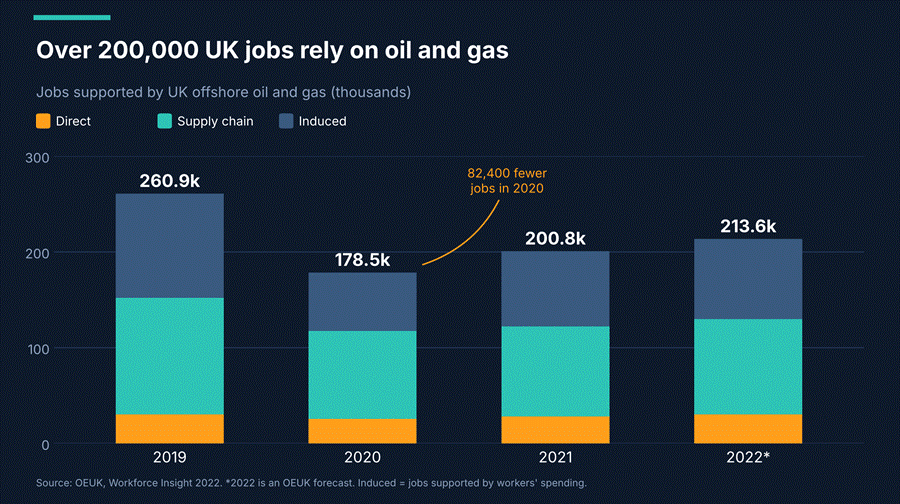
Figure 4. UK jobs supported by offshore oil and gas, 2019 to 2022. Source: OEUK.
The workforce is also getting older. OEUK’s Workforce Insight 2025 found that the average offshore worker was 44 in 2024, and that the number of offshore workers aged 65 and over rose by 25% between 2022 and 2024. OEUK notes that people are staying in work longer, which may leave fewer openings for new entrants.
Why this matters now
The government says Transitional Energy Certificates will sustain long-term jobs in North Sea communities. It has also set up a North Sea Jobs Service to help oil and gas workers move into defence, advanced manufacturing and renewables. That service is for people already in the industry. A school leaver needs a first job and a training place, and the oil and gas sector has provided both since 1999.
Supporters of the ban make a fair point. The government says North Sea production is in natural decline, so new licences would add little output, and it argues that investment and jobs should move to offshore wind, carbon capture and hydrogen, which use many of the same skills.
If that transition is the plan, the apprenticeship pipeline has to survive it. Programmes like APTUS need to keep recruiting at full strength while the North Sea changes, and the government should count them as part of its answer to the NEET figures. For many participants, an apprenticeship led to a profession and a long-term career. That is one of the UK upstream industry’s largest social contributions, and it should not be lost along with the licences.
Sources
- Office for National Statistics, Young people not in education, employment or training (NEET), UK: August 2026. https://www.ons.gov.uk/employmentandlabourmarket/peoplenotinwork/unemployment/bulletins/youngpeoplenotineducationemploymentortrainingneet/august2026
- Office for National Statistics, Young people not in education, employment or training (NEET), UK: May 2026. https://www.ons.gov.uk/employmentandlabourmarket/peoplenotinwork/unemployment/bulletins/youngpeoplenotineducationemploymentortrainingneet/may2026
- Office for National Statistics, Young people not in education, employment or training (NEET), UK: February 2026. https://www.ons.gov.uk/employmentandlabourmarket/peoplenotinwork/unemployment/bulletins/youngpeoplenotineducationemploymentortrainingneet/february2026
- Office for National Statistics, Young people not in education, employment or training (NEET), UK: November 2025. https://www.ons.gov.uk/employmentandlabourmarket/peoplenotinwork/unemployment/bulletins/youngpeoplenotineducationemploymentortrainingneet/november2025
- GOV.UK, Energy Independence Bill factsheet: Ending new oil and gas licences and introducing Transitional Energy Certificates, 4 November 2026. https://www.gov.uk/government/publications/energy-independence-bill-factsheets/ending-new-oil-and-gas-licences-and-introducing-transitional-energy-certificates
- GB News, Thousands of North Sea oil jobs lost in just one year, 30 April 2026 (OEUK’s Ben Ward on job losses). https://gbnews.com/news/north-sea-oil-jobs-lost-one-year-report
- Express & Star, UK Government to allow oil and gas extraction near existing North Sea fields (North Sea Jobs Service). https://www.expressandstar.com/uk-news/uk-government-to-allow-oil-and-gas-extraction-near-existing-north-sea-fields-5652125
- OPITO, Apprenticeships in the energy sector. https://opito.com/for-learners-opito/apprenticeships-energy-sector-opito
- OPITO, Apprenticeships for employers. https://opito.com/for-employers/apprenticeships
- OPITO, APTUS: Shaping the Future of Energy Through Skills and Innovation. https://opito.com/news/opito-aptus-apprenticeship-programme
- Energy Industries Council, OPITO and ECITB open applications for the APTUS apprenticeship programme, February 2025. https://the-eic.com/MediaCentre/Detail/articleId/2094?PageNo=2
- ECITB, Applications now open for the 2025 APTUS apprenticeship programme. https://www.ecitb.org.uk/news/applications-now-open-for-the-2025-aptus-apprenticeship-programme/
- OEUK, Workforce Insight 2022. https://oeuk.org.uk/wp-content/uploads/2022/11/OEUK-Workforce-Insight-2022.pdf
- OEUK, Economy and People Report 2024. https://oeuk.org.uk/wp-content/uploads/woocommerce_uploads/2024/06/Economy-and-people-report-2024-OEUK-fthaik.pdf
- OEUK, Workforce Insight 2025. https://oeuk.org.uk/wp-content/uploads/2025/11/Workforce-Insight- 2025-OEUK.pdf