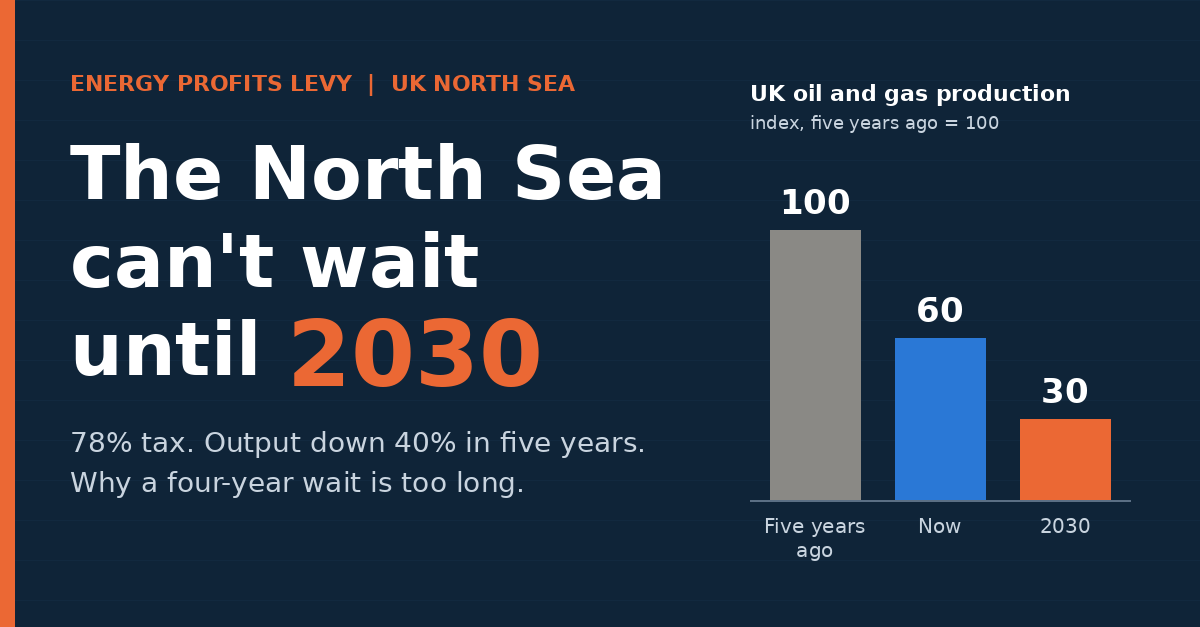
The government has already decided the Energy Profits Levy should be replaced. It has also decided to keep it for another four years. The North Sea does not have four years to spare.
When the Chancellor delivered the Budget on 28 October, he moved ahead with the replacement for the Energy Profits Levy, known as the Oil and Gas Revenue Levy, in the Finance Bill 2026-27. Then he declined to bring it in any sooner. The current levy stays until 1 April 2030.
That is a strange position to take. The new levy is permanent. It charges 35% only on exceptional revenue, when oil rises above $90 a barrel or gas rises above 90p a therm, and it falls away when prices return to normal. In other words, the government has looked at the Energy Profits Levy and concluded that a better tool exists. The question is why the industry is being asked to wait four years for it.
A windfall tax that no longer follows the windfall
The Energy Profits Levy was introduced in 2022 to catch the extra profits that came with a price spike. It has since grown to 38%, which, added to the 40% ring fence tax, takes the headline rate on North Sea profits to 78% (Figure 1). Offshore Energies UK points out that it applies regardless of market conditions. A windfall tax was meant to catch a windfall. This one applies whether or not there is one.
There is an early exit written into the rules, but it only opens if average prices fall below set thresholds for six months. Relief, in other words, arrives after the sector has already been hurt.
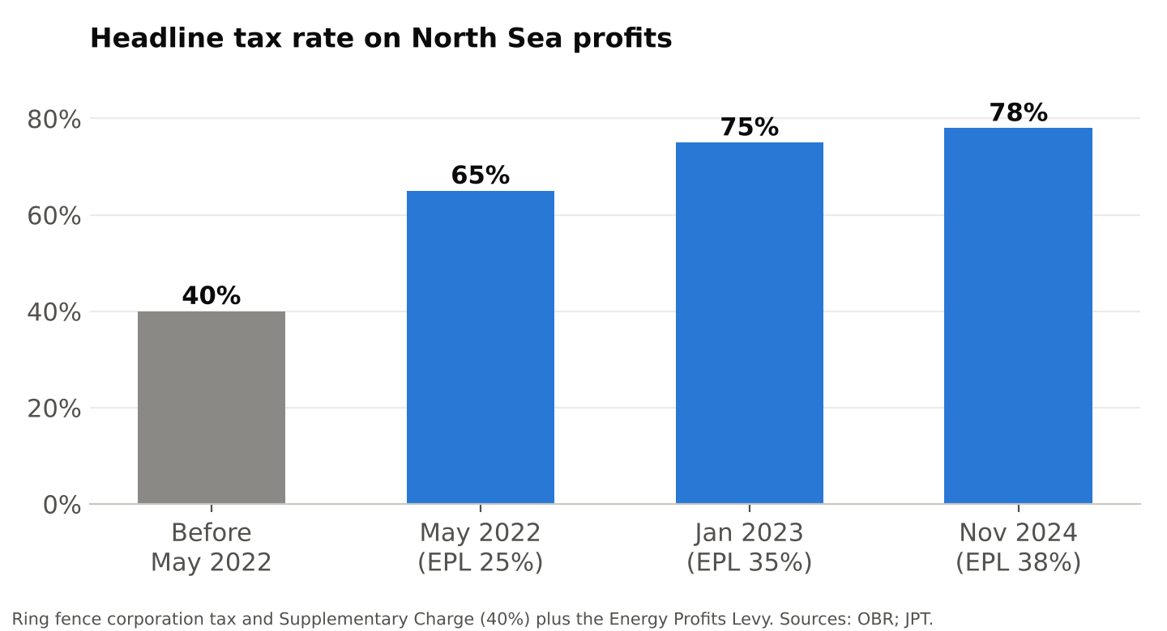
Figure 1. The headline tax rate on North Sea profits has almost doubled since 2022.
The tax base is shrinking
The Treasury is not getting more from this arrangement as time goes on. Government revenue from UK oil and gas production peaked at £9.0 billion in 2022-23 and had fallen to £4.3 billion by 2025-26, with levy receipts of £2.6 billion in the latest year, down from £2.9 billion (Figure 2). HMRC notes that levy figures can be affected by the timing of payments, and prices play a part in the fall. But output matters too.
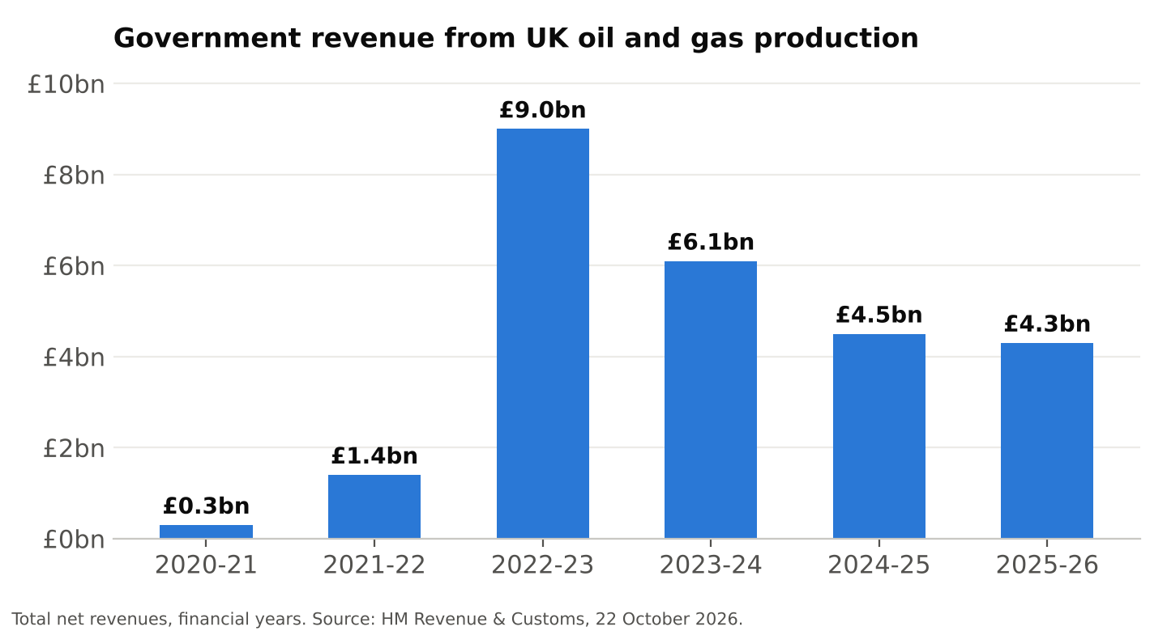
Figure 2. Government revenue from oil and gas production has halved since its 2022-23 peak.
OEUK reports that domestic production has fallen by around 40% over five years and is projected to fall by a further 50% by 2030 (Figure 3). OEUK calls that an accelerated decline driven by government policy, not geology. Whatever the exact cause, a tax that keeps its rate high while the thing it taxes keeps shrinking is not a plan for revenue. It is a plan for a smaller industry.
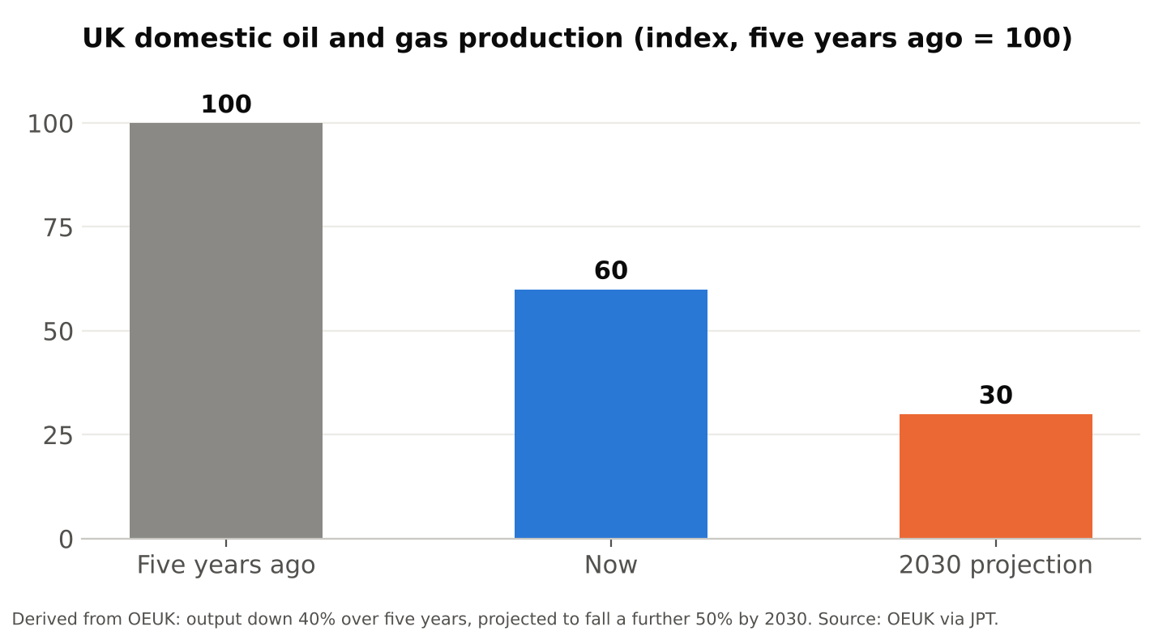
Figure 3. Production is on course to fall to less than a third of its level five years ago.
Investment decisions are made years in advance
A North Sea project takes years to plan and fund. Companies deciding where to put their money today look at the tax regime they will face over the life of the project, and they are looking at a 78% rate with a replacement they cannot use until 2030. OEUK says more than 100 projects are waiting, worth around £50 billion of investment by 2035 and 1.3 billion barrels of additional domestic production. It estimates that bringing the new levy forward to 2027 would raise nearly £15 billion more for the Exchequer. As its chief executive David Whitehouse put it, “2030 is too late.”
The signs of what delay does are already visible. The North Sea Transition Authority reports that no exploration wells were drilled in 2025, only three appraisal wells. The Aberdeen and Grampian Chamber of Commerce found confidence in the UK Continental Shelf at a net balance of minus 68, while 84% of respondents wanted the price mechanism introduced in 2026 rather than later. Companies there expect their international earnings to overtake their UK earnings within five years. Capital, kit and skilled people are not waiting around. They are moving to places that want them.
People, not just barrels
Behind every number is a workforce. The NSTA estimates that falling production cost the UK around 70,000 jobs between 2016 and 2023. Harbour Energy announced 100 more offshore job cuts in December 2025, on top of nearly 600 since 2022. OEUK says the industry supports more than 200,000 jobs across the UK. Once an experienced engineer, subsea technician or geoscientist leaves for Norway, the Gulf or West Africa, they rarely come back. And the same skills are the ones the energy transition will need for offshore wind, carbon storage and hydrogen.
Imports fill the gap
Britain does not stop using oil and gas because it produces less of it. OEUK warns that import dependence could rise from around 40% today to 80% by 2035 without new investment. We would then be buying abroad what we could produce at home, with the jobs, the tax and the emissions accounting all moved somewhere else.
The fair counterargument, and what I would do
The Treasury has a public finances problem and the levy still raised £2.6 billion last year. Certainty about a firm end date also has value, and ministers will say they have now provided one. Those are reasonable points. But the replacement levy is built to take a large share of any real price spike, so bringing it forward does not leave the public purse unprotected. That is why I would ask for three things:
- Bring the Oil and Gas Revenue Levy forward to 2027, as OEUK proposes.
- Keep the price floor that ends the old levy early, so the safety net is not lost.
- Publish a firm date for the transition and stick to it, so investors can plan.
A basin that has lost around 40% of its output in five years cannot afford a four-year wait. Whatever one thinks of oil and gas, the choice is not between production and no production. It is between producing at home with a sensible tax or importing the same energy and losing the benefit.
What do you think? Is 2030 a fair date or an avoidable delay?
Sources
Aberdeen & Grampian Chamber of Commerce. (2026, Spring). 43rd survey, energy transition.
HM Revenue & Customs. (2026, October 22). Government revenues from UK oil and gas production. https://www.gov.uk/government/statistics/government-revenues-from-uk-oil-and-gas-production–2/government-revenues-from-oil-and-gas-production-october-2026
HM Treasury. (2025, November). Oil and gas price mechanism consultation: Summary of responses. https://assets.publishing.service.gov.uk/media/6925a28722424e25e6bc315d/Oil_and_Gas_Price_Mechanism_Summary_of_Responses.pdf
Journal of Petroleum Technology. (2025). UK government keeps oil and gas windfall tax until 2030, trade groups warn of a perilous spiral. https://jpt.spe.org/uk-government-keeps-oil-and-gas-windfall-tax-until-2030-trade-groups-warn-of-a-perilous-spiral
North Sea Transition Authority. (2026, August 11). UKCS wells insights report 2026. https://www.nstauthority.co.uk/news-publications/ukcs-wells-insights-report-2026/
Office for Budget Responsibility. (2026). Oil and gas revenues. https://obr.uk/forecasts-in-depth/tax-by-tax-spend-by-spend/oil-and-gas-revenues/
Offshore Energies UK. (2025). OEUK 2025 reports dashboard. https://oeuk.org.uk/oeuk-2025-reports-dashboard/
Offshore Energies UK. (2026, October 28). 2026 Budget missed bigger opportunities says Offshore Energies UK. https://oeuk.org.uk/2026-budget-missed-bigger-opportunities-says-offshore-energies-uk/
Rigzone. (2026, October 29). OEUK says Budget “missed bigger opportunities”. https://www.rigzone.com/news/oeuk_says_budget_missed_bigger_opportunities-29-oct-2026-184960-article/